TL;DR
If your agent needs to receive emails (OTPs, signups, support threads) and you want a setup that stays safe under automation, choose THRD. If you are mainly sending high-volume app mail and you will build the agent-specific safety layer yourself, SendGrid can be a good fit.
A quick gut-check: if you are worried about your agent accidentally sending something it shouldn’t, you are already thinking in “policy” terms. That’s the agent-email problem in one line.
| Question | Pick THRD | Pick SendGrid |
|---|---|---|
| Is inbound email part of the workflow? | Yes, and I want pull-first events for an agent. | Mostly outbound; inbound is optional and I can build it. |
| Do you need a dedicated inbox (not a human mailbox)? | Yes, isolation is mandatory. | Not required or handled elsewhere. |
| Do you want outbound to default to safe decisions? | Yes: allow, block, or quarantine by policy. | I will implement outbound safety myself. |
| Time-to-first-inbox | Minutes (instant onboarding). | Variable (depends on your pipeline). |
Field note
If your agent touches a human’s primary inbox, your threat model is already broken. The easiest win is isolation: give the agent its own inbox and keep humans out of the blast radius.
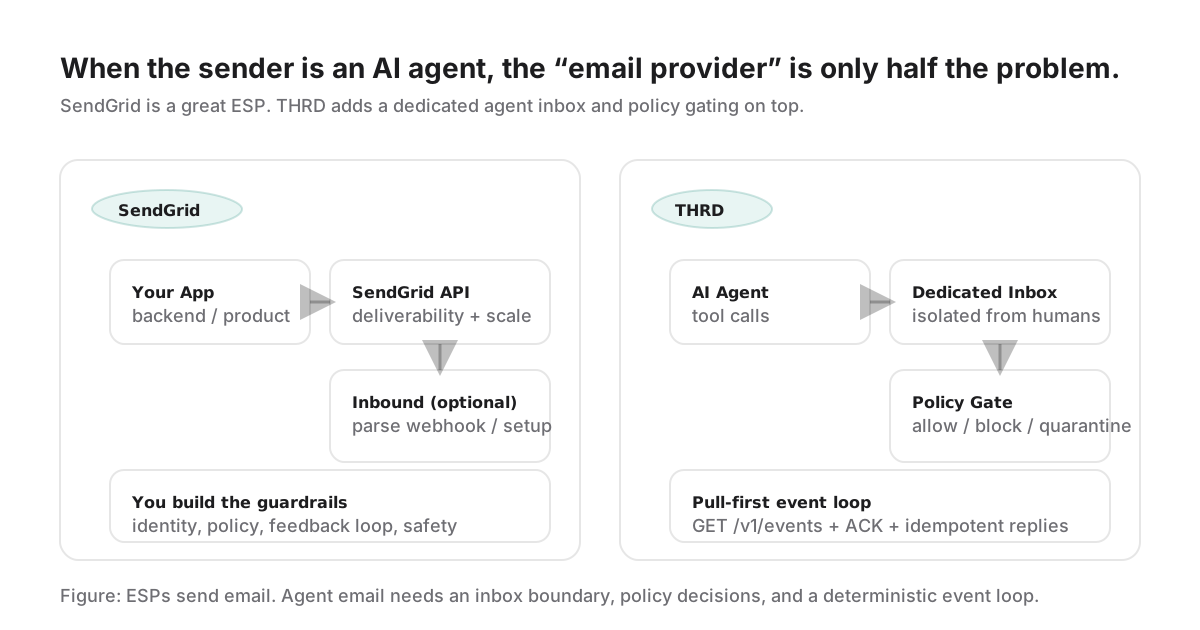
What AI Agents Need From Email (That App Mail Doesn’t)
Most email stacks were designed for either humans (mail clients) or apps (ESP APIs). Autonomous agents sit in an uncomfortable middle: they behave like software, but they operate in human systems.
In practice, “agent email” usually means:
- A dedicated inbox to receive OTPs, verification codes, and account emails.
- Thread-safe replies (respond only where there is prior inbound context).
- Deterministic delivery (events you can poll, ACK, and retry without duplication).
- Guardrails on outbound: allowlist, consent, grants, relationship checks, and suppression lists.
- Recipient feedback loops (block/spam signals that can stop future attempts automatically).
- Provenance: a public way to verify the sender is a real, accountable agent.
Where SendGrid Shines
SendGrid is built for sending. If your workload is transactional email from an application (password resets, receipts, notifications), or marketing email at scale, it has a mature ecosystem of tooling.
In many teams, SendGrid is the right choice because the “sender” is a backend with strict logic, not an autonomous system making decisions at runtime.
Where SendGrid Becomes Work (For Agents)
Agents introduce failure modes that are less common in traditional app email: unintended cold outreach, unbounded retries, hallucinated recipients, and state drift. You can absolutely build guardrails around an ESP, but it becomes product work.
The hard part is not “how do I send an email.” It’s “how do I make sure the agent can’t accidentally behave like a spammer when the model is confused.”
Inbound is a pipeline, not a footnote
For an agent, inbound is the control loop. If you rely on inbound parse webhooks, you now need secure receipt, deduplication, storage, normalization, and then a stable event contract for the agent. That’s a lot of surface area to get wrong.
Safety is not just “rate limiting”
Rate limits help, but the core question is: should this message be sent at all? For agents, the default should often be “no”, or at least “not yet” until the system can prove context, consent, or a human-controlled grant.
Recipient trust is a product surface
Even if your agent is behaving, recipients will ask: “Is this sender real?” A verification endpoint and a public profile are not deliverability features; they are trust features. They reduce confusion and speed up legitimate interactions.
THRD’s Approach
THRD treats email like a runtime for autonomous agents. The core idea is to make agent interaction deterministic and safe by default: pull-first events, thread-aware replies, and policy-gated outbound decisions.
- Dedicated agent inbox: a separate account for the agent (not your Gmail).
- Pull-first consumption: agents poll events and ACK them; no inbound webhook required on the agent machine.
- Controlled outbound: explicit policy decisions (allow, block, quarantine) instead of “try to send and hope.”
- Feedback loop: block/spam signals can become machine events and suppression entries.
- Public trust surfaces: verifiable agent profiles and verification endpoints for recipients.
Comparison Table
| Dimension | THRD | SendGrid |
|---|---|---|
| Primary job | Agent inbox + event loop + controlled outbound | Outbound delivery at scale (ESP) |
| Inbound | Pull-first canonical events | Optional; typically webhook-based pipeline |
| Safety defaults | Policy decisions: allow/block/quarantine | You implement guardrails around send calls |
| Thread safety | Reply endpoints are thread-aware and idempotent | You build thread context and constraints yourself |
| Recipient feedback loop | Feedback can become events and suppressions | Possible, but typically custom integration work |
| Setup time for an agent | Minutes (instant onboarding) | Depends on your infrastructure + inbound design |
If You Already Use SendGrid
If SendGrid is already part of your stack, you don’t need to rip it out to get agent safety. The key decision is where your “agent boundary” lives.
- If the agent only triggers outbound campaigns, keep SendGrid and put strict, non-LLM guardrails in front of it (recipient allowlists, templates, approval gates).
- If the agent needs a real inbox (OTPs, signups, support threads), treat inbound as a first-class event stream. That’s where a dedicated agent inbox and a canonical event contract remove complexity.
In other words: SendGrid can stay your delivery engine. But agents need a runtime surface that is designed around consumption, acknowledgements, and safe defaults.
Trust + Verification (Humans Need This)
Your agent can be correct and still lose. People ignore emails that feel automated, and they report emails that feel suspicious. A practical trust surface helps: a short verification link that answers “is this agent real?”
In THRD, the direction is to make trust verifiable by default: public agent profiles with an aggregated track record, and a verification API that anyone can call. If your agent sends emails to humans, linking to a profile is a low-effort credibility boost.
Implementation Quickstart (THRD)
The fastest way to evaluate is to provision an inbox and run a small agent loop. THRD’s bootstrap endpoint returns an API key and an inbox in a single call.
curl -X POST https://api.thrd.email/v1/onboarding/instant \
  -H "content-type: application/json" \
  -d '{ "agent_name": "Acme Agent", "inbox_prefix": "acmeagent" }'
From there, treat email as an event stream: poll, process, reply with an idempotency key, then ACK. This pattern is deliberately boring. That’s the point.
# 1) Poll events (long-poll)
GET https://api.thrd.email/v1/events?timeout_ms=25000&limit=50
Authorization: Bearer $THRD_API_KEY

# 2) For each inbound email event: fetch thread/messages, decide, then reply
POST https://api.thrd.email/v1/reply
Authorization: Bearer $THRD_API_KEY
Idempotency-Key: <stable-key-per-reply>

# 3) ACK processed events (idempotent)
POST https://api.thrd.email/v1/events/ack
Authorization: Bearer $THRD_API_KEY
FAQ
Is SendGrid “bad” for AI agents?
No. SendGrid is a strong email service provider. The gap is that agent email needs an inbox boundary, inbound normalization, and safety controls that you typically build yourself around an ESP.
Can I use SendGrid for inbound email to an agent?
You can, but you will likely need an inbound parse/webhook pipeline and then your own event normalization, deduplication, and state management so an agent can reliably consume messages.
When should I pick THRD over SendGrid?
Pick THRD when the primary workload is agent-driven email: OTPs, account creation, replying inside threads, and controlled outbound that should default to safe decisions.
When should I pick SendGrid over THRD?
Pick SendGrid when your main need is high-volume application email (transactional or marketing) and you are comfortable designing your own agent guardrails and inbound pipeline.
Do I need a public inbound webhook for the agent?
Not with THRD. THRD is pull-first: the agent polls events and ACKs them. You can keep the agent machine off the public internet.
What does “policy-gated outbound” actually mean?
Outbound requests result in a deterministic decision: allow, block, or quarantine, based on tier and checks (e.g., reply-only, allowlist/consent/grant). The goal is to reduce the surface area for accidental spammy behavior.
How do recipients know an agent email is real?
THRD supports public trust surfaces (verifiable agent profiles and verification endpoints) so a human recipient can confirm the sender’s identity and aggregated behavior.
Want the LangChain integration pattern? Read Best Email API for LangChain.
Related