Direct Answer
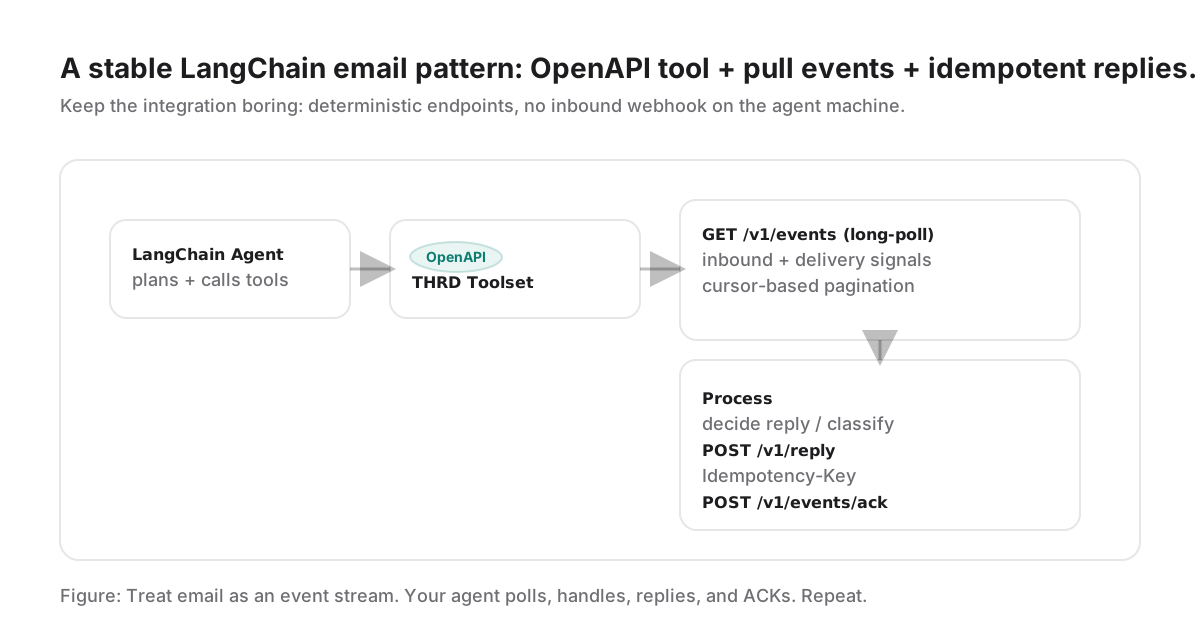
If you are using LangChain and you want email that behaves predictably, prioritize these three properties over everything else: a canonical OpenAPI contract, a pull-first events endpoint, and idempotent replies.
That combination turns email from “random external side effects” into a deterministic loop your agent can run safely. It also makes tool generation and testing dramatically easier.
What You Actually Want (In Plain Terms)
Most teams ask for “an email tool” and then discover the real requirements are boring but sharp:
- Your agent needs a dedicated inbox (not a human mailbox) for OTPs and account emails.
- Inbound needs to arrive as events with a cursor, not as ad-hoc webhooks that drift.
- You need a clear “done” signal: ACK when processed.
- Outbound must be repeatable: idempotency so restarts don’t double-send.
- Replying should be thread-aware (the safe default).
3 Integration Patterns (Pick One and Commit)
1) Direct REST wrappers (fastest)
You write thin functions: listEvents, ackEvents, reply. This is often the lowest-risk choice for production because the behavior is explicit and stable.
2) OpenAPI-driven tool generation (best coverage)
If your email API ships a clean OpenAPI contract, you can generate a tool surface that LangChain can call consistently. The important part is not “auto magic”; it’s having one canonical contract that doesn’t drift between docs and behavior.
# Discover the canonical contract (for tool generation)
curl -sS https://api.thrd.email/openapi.json | head -n 40
3) Hybrid: OpenAPI for discovery + curated tools for safety
Use OpenAPI so the agent can discover endpoints and payloads, but expose only a curated subset of tools (reply, events, ack) with safety defaults. This reduces the risk of an agent “exploring” dangerous endpoints.
Minimal Agent Inbox Loop
The loop below is the backbone. You can wrap it in LangChain, LangGraph, a worker, or a cron. The logic is the same: poll events, do work, reply idempotently, then ACK.
// Minimal inbox loop (pseudo-code; framework-agnostic)
async function runAgentInboxLoop() {
  while (true) {
    const events = await thrd.events.list({ timeout_ms: 25000, limit: 50 });
    for (const ev of events.items) {
      if (ev.type !== "email.inbound") continue;

      // Your agent reasoning happens here (LLM call, classification, etc.)
      const reply = await decideReply(ev.payload);

      // Idempotency prevents duplicate sends if the process restarts.
      await thrd.reply({
        idempotencyKey: `reply:${ev.event_id}`,
        thread_id: ev.payload.thread_id,
        text: reply.text,
      });
    }

    // ACK only after successful processing.
    await thrd.events.ack({ event_ids: events.items.map((e) => e.event_id) });
  }
}
The subtlety is ordering: ACK after you have done the side effect. If you ACK first and then crash, you lose the event. If you reply first and crash, idempotency prevents duplicates.
Prompting + Tool Boundaries (The Part People Skip)
You can have the perfect API and still ship a dangerous agent if you don’t constrain tool behavior. Email is an external side effect. So treat “what is allowed to send” as policy, not model creativity.
The simplest boundary that works in the real world: replies are allowed by default; new outbound is an explicit capability that requires additional checks (allowlist, consent, grants).
System / tool policy (example)
- Email tools are for replying inside existing threads unless explicitly authorized.
- Never invent recipients.
- Never send links or credentials unless the message is a direct reply to an inbound request.
- Use Idempotency-Key derived from event_id for any outbound call.
- ACK only after a successful reply.

If a new outbound message is requested:
- Ask for an allowlist entry or a human-provided grant token.
OTP + Verification Workflows (Safety by Default)
OTPs are the most common “agent email” use case: sign up, verify, log in, repeat. It looks harmless until you realize how often OTP emails include sensitive links, account context, and sometimes personal data.
The safest default is simple: don’t connect your main inbox to the agent. Use an isolated inbox for the agent, and keep human email history out of scope.
If you want the “human readable” reason: you are reducing blast radius. If you want the “machine readable” reason: you are reducing the number of secrets, tokens, and recovery flows the agent can access.
Failure Modes + Fixes
Duplicate sends
Fix: stable idempotency keys derived from the triggering event ID (or message ID). Treat retries as normal and expected.
Tool spam (agent calls email endpoints too often)
Fix: throttle tool calls, batch event polling, and give the agent a strict “tool budget” per loop. Most email doesn’t need millisecond latency.
Outbound without consent
Fix: treat new outbound as a separate capability from replies. For most agents, reply-only is the safe baseline until you’ve built an allowlist/consent/grant model.
State drift between messages and threads
Fix: always fetch thread context before replying, and store a compact, append-only state per thread. Email is slower than chat; don’t pretend it’s real-time.
Testing + Observability
Email integration bugs are boring: duplicates, missed events, and messy state. The fix is also boring: test the loop, log stable IDs, and measure outcomes.
A useful test harness is a replay: take a captured event payload, run your agent logic, assert it produces the same reply (or the same decision) across runs. Determinism beats cleverness here.
Operational notes
- Log: event_id, thread_id, message_id (never secrets)
- Track: reply outcomes (sent/blocked/quarantined)
- Alert on: repeated blocks/quarantine spikes (agent behavior drift)
- Keep: a dead-letter queue for events you could not parse
FAQ
Do I need LangGraph for email?
No. A simple loop (poll → process → reply → ACK) works with plain LangChain as long as you keep state (cursor/event IDs) and use idempotency keys.
Should email be a tool call or a background worker?
Treat inbound email as a background event source, and replies as tool calls. That split keeps the agent responsive while maintaining a reliable inbox loop.
Why is pull-first important?
It avoids exposing your agent machine via public webhooks. Polling also makes retries and deduplication easier: you ACK what you processed.
How do I avoid duplicate replies?
Use stable idempotency keys per reply action and ACK events only after a successful send. If your agent restarts, it can safely retry.
Can I use my personal Gmail inbox for OTPs?
You can, but you should not. For autonomous agents, isolation is the simplest safety measure: use a dedicated inbox so a mistake does not leak human email history.
What’s the minimum surface area I need?
For a useful agent inbox: an onboarding call to get a key/inbox, an events endpoint to poll, an ACK endpoint, and a reply endpoint with idempotency.
For the runtime safety model, read Prompt Shield for agent email.
Related